Science - Water Transportation Experiment

Recently, in 3V we have been looking at the secret life of plants.  We have been learning all about how plants stay alive, including looking at the way in which they adapt to different surroundings.  We learnt how plants growing in desert conditions conserve water, and how plants growing under the dark rainforest canopy manage to maximise their exposure to light.

This week, we have been looking at the inside of plants, and how they transport nutrients and water from their roots to their leaves.  We have been practising our scientific thinking skills in order to design an experiment to try to prove that water travels up the stems of plants.  

To do this, we carefully measured out plain water and dyed it blue with food colouring, before adding a stick of celery to the water.  In order to keep the experiment fair, we also put a stick of celery in the same amount of plain water to see whether the results were different.  This is called the 'control.'

Normally, Mrs Vaqueiro would leave the experiment overnight and then have the class look at the results 24 hours later, but this year we didn't have to be so patient!  The celery drew up the blue water almost before our very eyes, and by the time we had finished writing up our experiment and drawing a diagram, the leaves at the top of the celery stalks had started to turn blue!  We are excited to see whether they turn an even darker blue overnight.


Literacy Work - w/b Monday 27th September 2021


For our literacy work this week, we will be exploring ‘The Day the Crayons Quit’ by Drew Daywalt.  You can watch a version of the story here:

https://www.youtube.com/watch?v=489micE6eHU

In order to support your child at home, you could:

1. Practise using the word of the week, atrocious

2.  Encourage them to think about how each of the crayons is feeling in the story.  What were the clues in the story that helped you to know how each one feels?

Any work that your child completes at home can be used to support their literacy work in class.

Thank you.

Mrs Vaqueiro 


Hindu Prayer and Worship

In our RE lessons this half term, we are learning all about Hinduism.  Today, we have been looking at Hindu worship, which is called Puja.  Hindus try to worship every day, either at the temple or at home.  Many Hindu families have a special area, or shrine, in their home for worship. 

Today, the children found out about some of the rituals and artefacts that Hindus might use in their daily prayers.  We were very lucky to be able to borrow a selection of artefacts for the children to explore.  Everyone enjoyed ringing the bell!  

We thank Mrs Smith for very kindly loaning us her Puja tray and model deities, which helped to bring the lesson to life for the children.


Write Like an Ancient Egyptian!

In our history lessons this half term, we have been learning all about life in Ancient Egypt.  

Today, we looked at Ancient Egyptian writing.  We learnt that the Ancient Egyptians used different symbols to represent words and letters of the alphabet, and these were called hieroglyphs.

We learnt that, for many centuries, the meaning of hieroglyphic writing was a mystery, as there was nobody still alive who could understand the symbols.  However, in 1799, an incredible stone artefact was uncovered in the Nile Delta, which helped archaeologists to translate the ancient writing.  It was called the Rosetta Stone.

This afternoon, the children had a go at using their own mini Rosetta Stone to translate some hieroglyphic messages into English.  Then, they wrote and decorated their own names in Ancient Egyptian hieroglyphics.

If you'd like to have a go at cracking the Ancient Egyptian hieroglyphic code, here's a copy of our 'Rosetta Stone' and the secret messages that the children had to translate!  Perhaps you could have a go at writing your own name too - it's trickier than it looks!


Literacy Work w/b Monday 20th September 2021


Literacy w/b Monday 20th September 2021

For our literacy lessons this week, we will be continuing our work on ‘Meerkat Mail’ by Emily Gravett.  For Big Writing on Friday, the children will be asked to retell the story in their own words, using the work they have done in class to support and enhance their versions of the story.

To refresh your child's memory of the story, you can watch a version of it here:  Meerkat Mail Story

In order to support your child at home, you could:

1. Practise using the word of the week, ecstatic

2. Encourage them to retell the story in their own words, focusing on linking and sequencing the events in the correct order.

3. Think about and discuss how the main character, Sunny, feels at the different stages of the story.

Any work that your child completes at home can be used to support their literacy work in class.

Thank you.

Mrs Vaqueiro 


Dictionary Skills

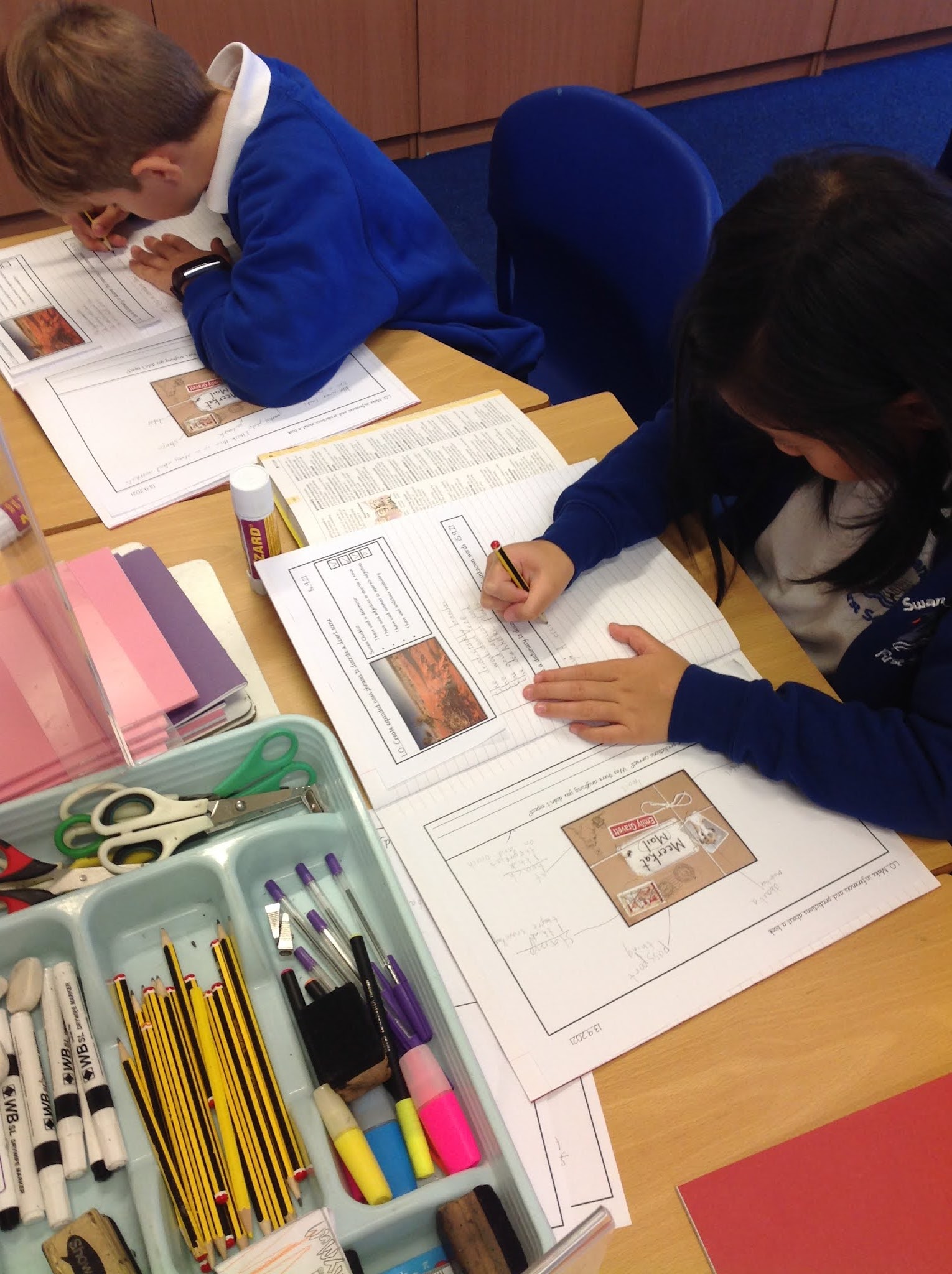
As part of the Year 3 English curriculum, children are encouraged to work more independently and use information and resources in the classroom to support their learning.  Today, we began with a lesson on how to use a dictionary to find out the meaning of words.  Although this sounds simple, there are a number of different skills at play here, from knowing the alphabet in order to checking spellings carefully.  

Using the dictionary independently and accurately is a key skill for Year 3, so if you have a dictionary at home, you could support your child's learning by helping them to practise looking up any new words to check their meanings.


Literacy Work w/b Monday 13th September 2021


Literacy w/b Monday 13th September 2021

For our literacy work this week, we will be making a detailed study of ‘Meerkat Mail’ by Emily Gravett.  

You can watch a version of the story here:  Meerkat Mail Story

In order to support your child at home, you could:

1. Practise using the word of the week, arid

2. Find out all about meerkats in the wild.  Where do they live?  What is it like there?

3. Think about and discuss how the main character, Sunny, feels at the different stages of the story.

Any work that your child completes at home can be used to support their literacy work in class.

Thank you.

Mrs Vaqueiro